Running a GmbH in Germany: accounting, costs and bureaucracy

I run Stagetimer, a bootstrapped SaaS, as a small German GmbH. This is what that takes after the founding: the accounting setup, the monthly to yearly tax duties, the fees, and the bureaucracy around it. Read From Einzelunternehmen to GmbH for my experience creating a German GmbH.
#Accounting setup
Bookkeeping: Lexware Office (referral link). I already used it for the Einzelunternehmen, so the GmbH got a fresh account and I moved over 111 invoices from January to April.
All tax things (VAT returns, EU sales reports) run through it. I took the largest plan because it includes API access, and hooked it up to my AI agent.
Payroll: the Lexware Lohn & Gehalt add-on, inside the same tool.
Tax advisor: does the annual financial statements (Jahresabschluss) and the opening balance sheet. Everything else I do myself.
Finding a tax advisor. The real obstacle for German founders. Many tax advisors don’t take on small new clients, and you should have one before you make your first Euro. Ask other founders for referrals, and start looking early. For a GmbH you can’t do without one.
Bank: Qonto (referral link).
Payments: Paddle as merchant of record for all self-serve subscriptions, as explained in How to collect money without accidentally summoning a tax inspector. For enterprise invoices I switched to Stripe Invoicing, because Lexware can’t do localized number formats, currencies other than EUR, or a card payment link. The bookkeeping still goes through Lexware.
#Recurring duties
Monthly: VAT return, wage tax return, payroll.
Quarterly: EU sales report (for EU B2B customers), corporate tax prepayment (tax office), trade tax prepayment (city).
Yearly: annual financial statements and their publication in the company register, corporate, trade and VAT tax returns, the wage report to the Berufsgenossenschaft, the IHK fee, the Transparenzregister fee, and the §22 UmwStG proof of ownership for 7 years.
#Running costs
Per year, without the taxes themselves:
| Item | Per year |
|---|---|
| Tax advisor (annual financial statements, tax returns) | €2,500+ |
| Lexware Office XL (€32.90 per month, net) | €394.80 |
| Lexware Office payroll add-on (€12.90 per month, net) | €154.80 |
| Qonto business account (€23 per month) | €276 |
| Public Broadcast fee: Tier 1 (€36.72 per quarter) | €146.88 |
| IHK membership (provisional) | €114 |
| Transparency register | €19.80 |
| Unternehmensregister: publishing the annual financial statements (third-party estimate) | ~€50 |
| Berufsgenossenschaft | Based on payroll, billed after the year ends |
| Health and long-term care insurance (paid personally; mandatory; maximum contribution) | ~€14,300 |
For comparison: my previous tax advisor charged about €3,000 net per year for the Einzelunternehmen (profit statement plus income, trade and VAT tax returns). Tax advisor fees follow a statutory fee schedule (StBVV) and grow with profit and revenue.
IHK membership fee. Every GmbH is a compulsory member of its chamber of commerce. Mine sent a provisional fee notice of €114 for 2026, with a final calculation to follow once the profit is known. It found the GmbH through the commercial register, even before the trade office processed my registration.
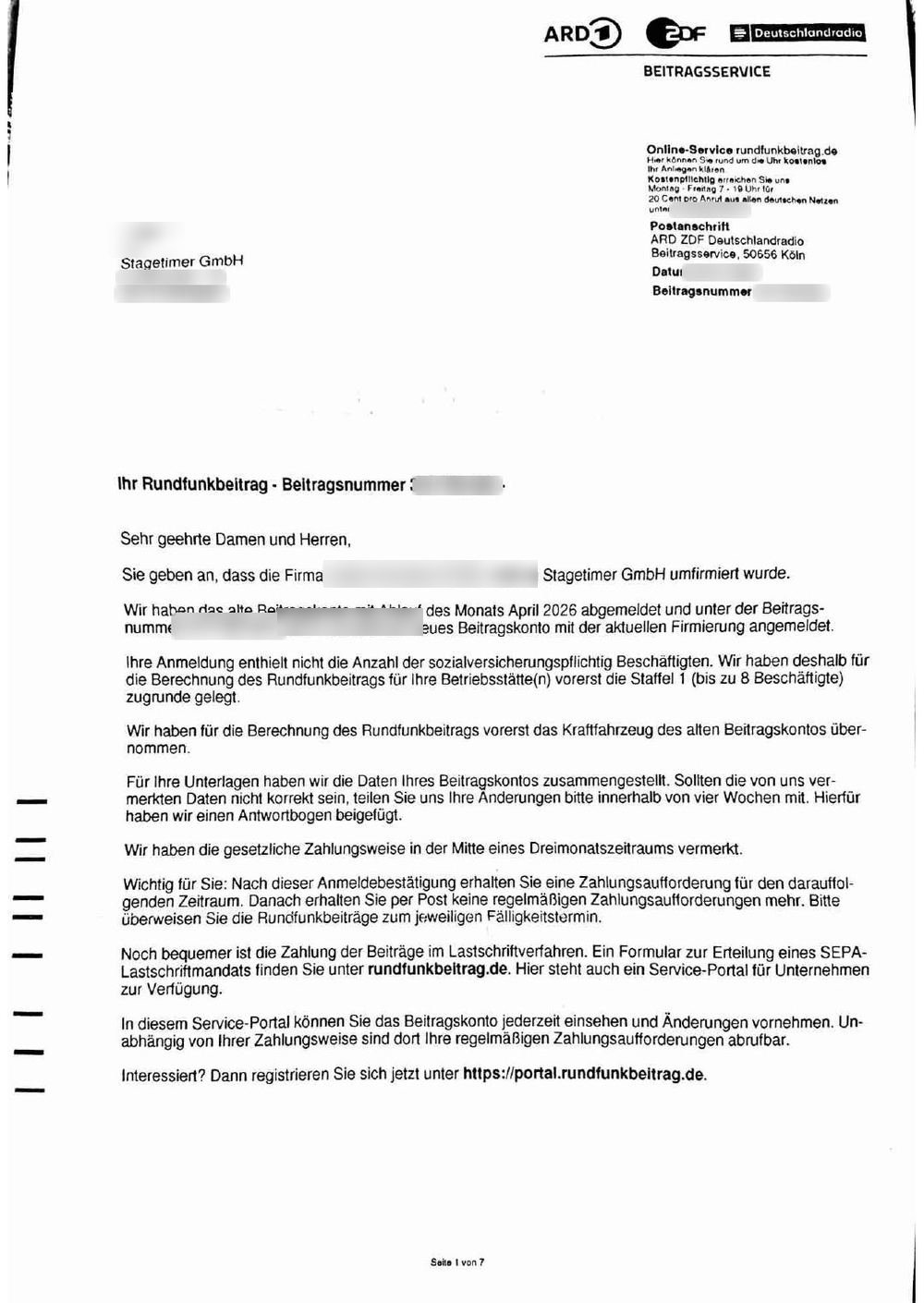
Rundfunkbeitrag (public broadcasting fee). It’s charged per household and per business location, so the company pays separately from my private household. Mine also counts the company car, which as far as I understand shouldn’t cost extra. A correction request is pending.
Health insurance. As the controlling managing director of my own GmbH, social security treats me as self-employed, so I pay 100% of my health insurance myself. I’m publicly insured, which charges a percentage of income up to a ceiling (Beitragsbemessungsgrenze, €5,812.50 per month in 2026). I pay the maximum contribution (Höchstbeitrag): about 17% for health and 3.6% for long-term care (Pflegeversicherung), around €1,190 per month. With little income you still pay a few hundred Euros per month, because public insurance assumes a minimum income for the self-employed. Private insurance looks cheaper when you’re young and single, and gets expensive with family and age. Switching back is hard.